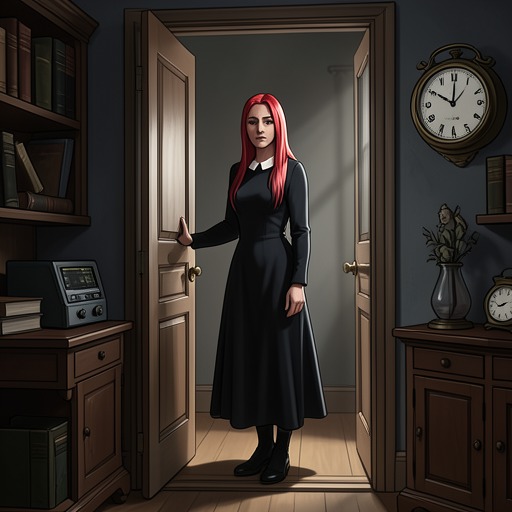
Amy Hide · Mary Lamb—Jamie
Other PeopleThe relationship between Amy Hide / Mary Lamb and Jamie is a companionship shaped by need, intimacy, and unequal forms of power. Jamie offers Mary a place beside him as she moves through uncertainty and loss, while Mary increasingly organizes their shared life around his dependence on her. Their closeness becomes an enclosure from ordinary time and social life; within it, Mary eventually recounts the story of her death and return, and recognizes herself again. The relationship matters not as a simple rescue or romance, but as the setting in which care, control, and Mary’s recovering identity become difficult to separate.
First Encounters and Uneasy Affection
Mary follows Jamie after he reacts angrily to Michael Shane. Jamie calls Michael a scumbag and complains that he is treated badly and expected to run errands for him. His protest is both defiant and uncertain: he says he is leaving, then tries to draw Mary back into contact, asking whether she wants to see him again and requesting her number. Mary says she would like to see him. The exchange establishes a pattern that recurs in their relationship: Jamie pushes away and seeks reassurance almost in the same breath, while Mary remains attentive to his shifts in mood.
When they part, Jamie asks Mary to think of him and not to break. The appeal acknowledges her vulnerability without explaining it, and makes their farewell more intimate than a casual parting. It also gives their later companionship a note of foreboding: Jamie’s words are a wish for endurance, but the story shows both of them entering a period in which endurance will mean remaining together inside a narrowing world.
Their connection develops alongside Mary’s continuing emotional attention to Alan. After walking with Jamie through the park, she imagines love as a circle of people joining arms, imperfectly, to protect one another. She still thinks of herself as someone who will protect Alan and hopes he will also be among those protecting her. She intends to tell him so. Jamie’s presence, then, does not simply replace Mary’s attachment to Alan. The contrast shows Mary trying to make room for several forms of care even as her circumstances draw her toward a much more concentrated bond with Jamie.
Closeness and Social Separation
Jamie and Mary are together at a gathering where Jamie, excited and drunk again, surveys the people around them and declares that they have all done it to one another. He asks whether Mary has done it to anyone there. The meaning of his phrase is left unstated, but the scene makes his view of the group plain: shared conduct, rather than individual distinction, is what binds its members. Mary is still uncertain about how to understand the people around her, and Jamie’s remark places her on the edge of a social world whose rules she has not mastered.
Jamie also accompanies Mary in quieter, more tentative gestures. He walks her halfway home, to the misty center of the park, and asks whether she minds holding hands. Mary agrees. At the pond they struggle to find a natural way to say goodbye; Jamie squeezes her arm, walks away, then turns back to wave while walking backwards. The awkwardness of the farewell gives their connection a gentleness distinct from the drunken, confrontational social world around them. Their affection is expressed not through certainty about what they are to each other, but through small requests and hesitant departures.
That tenderness does not prevent the relationship from becoming difficult. When Augusta recalls Mary’s earlier statement about loving someone so much that she would not mind being killed by him, the recollection sits among conversations that blur Mary’s past and present. The evidence does not identify the person in that remembered statement, so it cannot be treated as a declaration about Jamie. Its presence nevertheless emphasizes how other people’s memories of Mary may carry a version of her experience that she herself is still struggling to recover.
Testing, Hurt, and Power
Mary’s treatment of Jamie changes when she recognizes that she can hurt him. After he shares a poem, Mary sees its intended humor but neither laughs nor smiles. Jamie’s expression shows that her response has wounded him; he asks whether she has to read the whole thing and looks away. Mary is appalled by what she has done, yet concludes that she would do it again. She identifies the ability to make another person feel bad as a power available to her and decides that she may as well use it.
This moment complicates any account of Mary as simply dependent on Jamie. Her uncertainty and isolation remain, but she is also learning to act upon the relationship rather than only receive what it offers. The power she names is narrow and painful: it consists not in changing her circumstances, but in producing hurt in someone close to her. Jamie’s visible reaction makes the cost immediate. Their intimacy gives Mary access to him, and that access allows her to wound him; her discovery of agency therefore arrives as a change in the balance between them, not as a clean escape from vulnerability.
Jamie later tells Mary that he is no longer able to manage the future or meet her demands, describing himself as exposed and overwhelmed. Mary responds by taking control of the exchange and turning it toward intimacy. The moment reverses their earlier pattern of Jamie seeking reassurance: he voices his weakness, and Mary answers with a decisive instruction. When she wakes, she feels that her eagerness and distress have passed. Jamie is beside her, smoking and staring at the grey window, his face marked by remorse. The scene conveys both a change in Mary’s state and Jamie’s discomfort afterward, without making their closeness a straightforward resolution.
Shared Life and the Return of Identity
In the later period at Jamie’s flat, the pair shape their days around drinking, sleep, food, and repeated nights awake. They deliberately unsettle the ordinary division between day and night: after several hours of drinking, they eat around midday, sleep for six or seven hours during the afternoon, then rise to begin another long night. Their routine has its own insistence, but it also signals withdrawal from the shared timetable by which other people organize life.
Mary takes increasing charge of their domestic life. She cooks elaborate meals in the cramped kitchen and is surprised by her own competence and firmness in making decisions there. Jamie, meanwhile, eats less than he once did, and their closeness is presented alongside his physical and emotional decline. During their first nights together, Mary talks at length about his unfinished life and about the narrator’s assertion that he is secretly queer and mad. Later they no longer talk as much; the narrative presents their silence as a sign of closeness, though it also belongs to a life increasingly enclosed by drink, sleep, and routine.
At their last meal, Mary tells Jamie the whole story as she understands it: her death, her new life, her murderer, and the redeemer she expects will come for her. Jamie leaves his food untouched. Mary’s distress becomes overwhelming, and afterward she stands before the mirror in darkness, hearing laughter. When she turns on the light, she recognizes that she has crossed back through the glass and found herself again. Jamie has been the companion within the isolation where she tells this story, but the passage gives him no explicit role as the person who restores her identity. That recognition belongs to Mary herself.
The relationship thus ends at a point of transformation rather than a settled promise between the two. Jamie’s earlier wish that Mary not break echoes through their shared endurance, but her return to herself is not presented as the consequence of his saving her. Their bond has provided companionship and a setting for disclosure, while also revealing how care can become dependence and how intimacy can give way to control. The distinction matters: Jamie is central to the life Mary inhabits during this period, but the final recovery is her own.